fbpx

Galapagos 5 Day Route B aboard Treasure of Galapagos

Galapagos 5 Day Route B aboard Treasure of Galapagos

5BTAT
Call for Price

Description

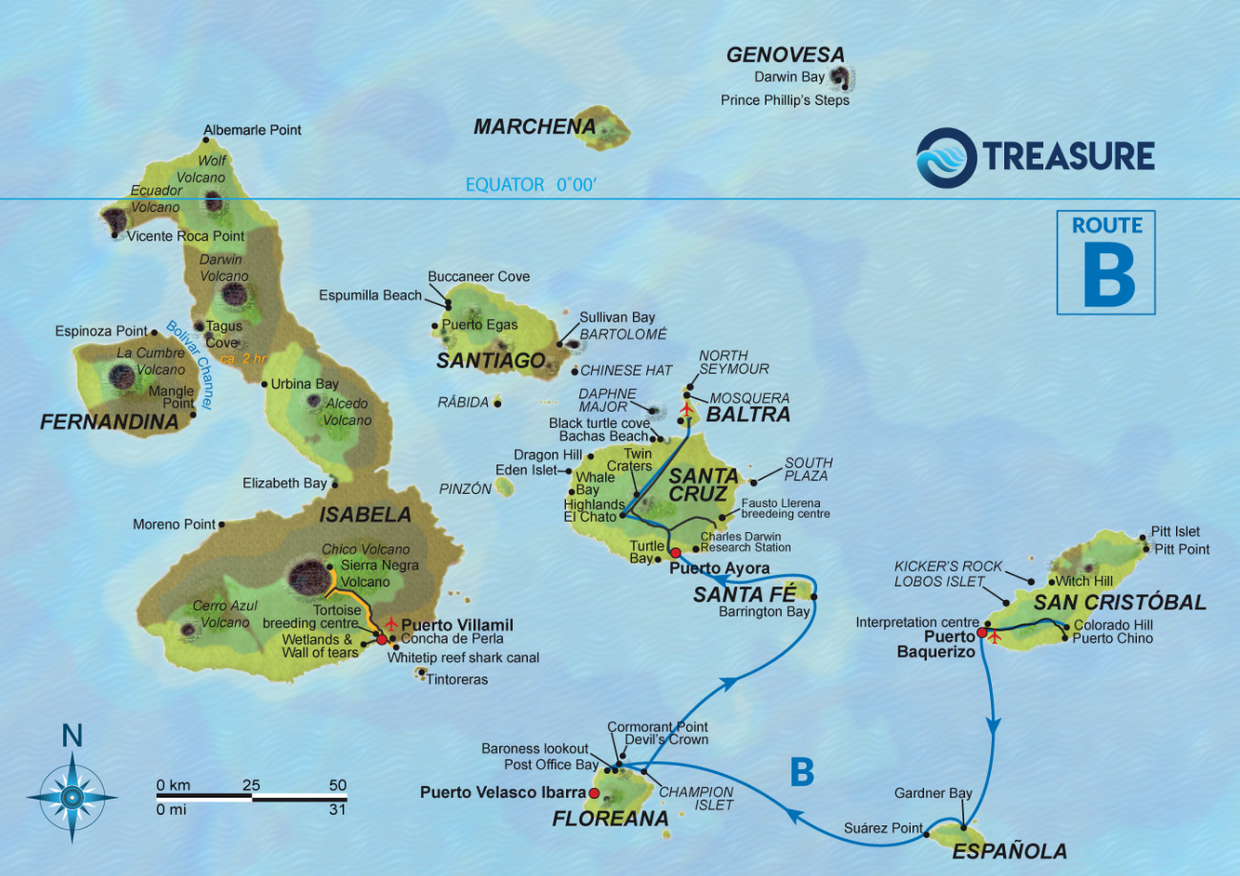
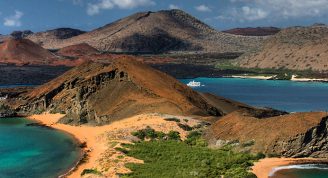
Our classic 4-night route to the southeast Galapagos Islands anchors at the most paradisiacal bays and lovely beaches. Some of these oldest islands are true crown jewels where you can become an eye-witness of evolution. Several (sub) species have had enough time to transform into emblematic figureheads, which differ from island to island. Moreover, the open water passages take 4-6 hours instead of long overnight navigations; our stable catamaran mostly floats at sheltered anchorages, which helps you get a restful sleep.

Trip Name
Galapagos 5 Day Route B aboard Treasure of Galapagos
Days
5
Overview
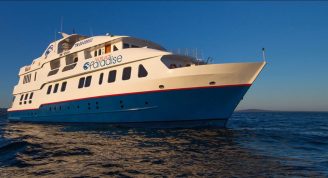
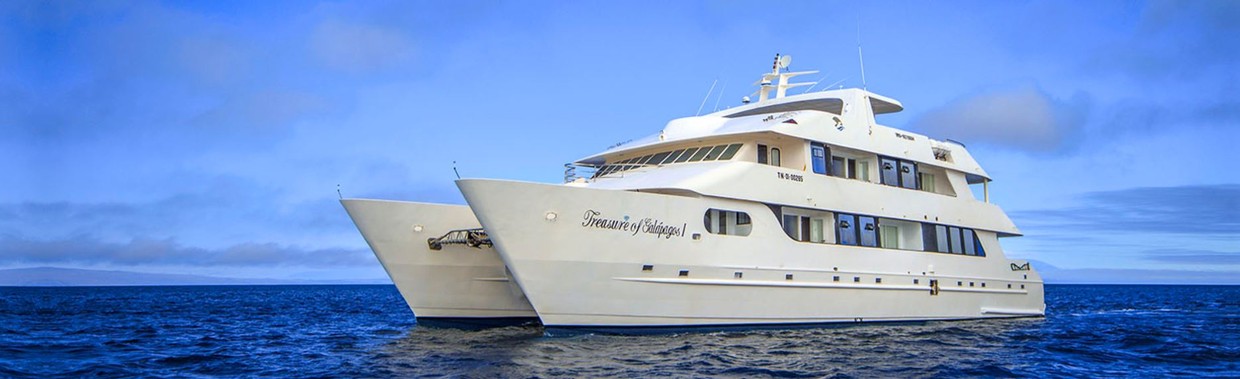
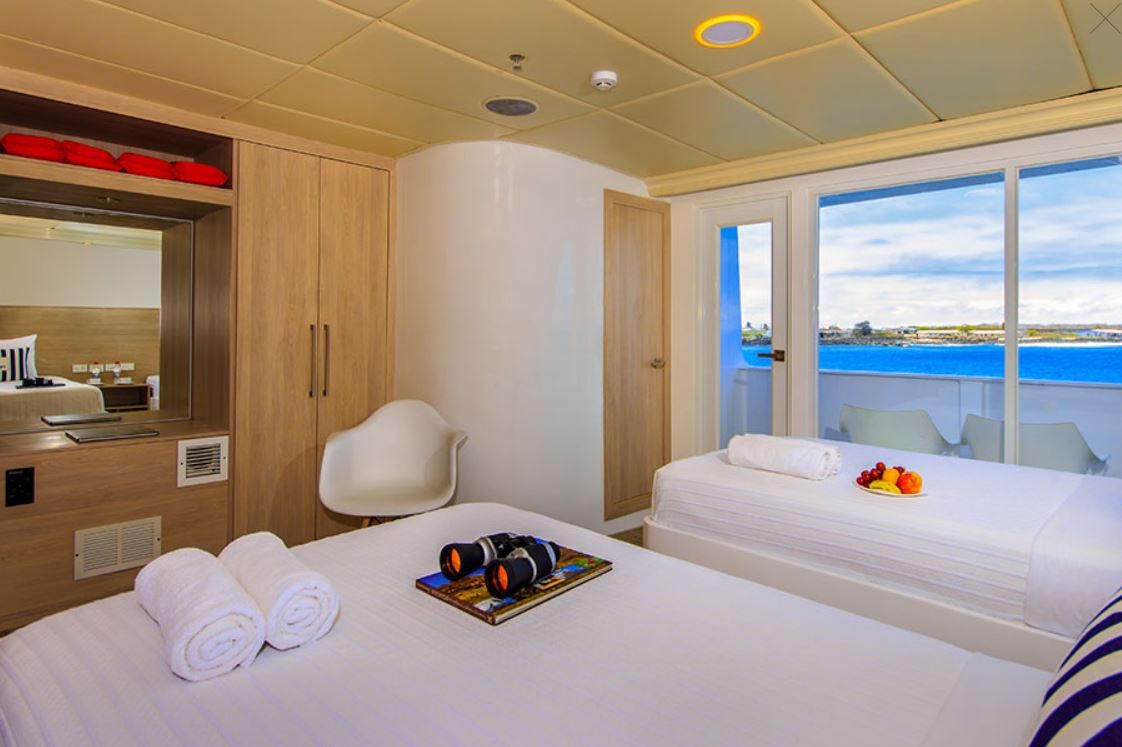
Vessel Type: Motor Catamaran Passenger Capacity: 16 Length: 31.6 m Built: 2009 The Treasure is a first-class motor catamaran purpose-built for cruising the Galapagos Islands, offering an intimate and elegant experience for up to 16 passengers with a guide. At 31 m in length and 11.2 m in beam, the yacht features private balconies on all cabins, including a master suite on the main deck, and bright 20 m² cabins with en-suite facilities, air-conditioning, bathrobes, and indoor seating areas. Social and leisure areas include a sun deck with solarium, shaded relaxation zones, and a whirlpool, an air-conditioned main-deck lounge with dining and bar, and an upper-deck terrace with barbecue. The vessel maintains high safety standards with IMO certification, GPS, radar, sonar, VHF radios, and an EPIRB, while cruising at 9 knots (max 11 knots). Built in 2009 and remodelled in 2022, the Treasure combines comfort, privacy, and sustainable operation in the fragile Galapagos environment.
Itinerary


Day 1 - DAY 1 - TUESDAY AM - Flight to San Cristobal Airport (SCY) & PM - Colorado Hill (San Cristobal)
Upon arrival at San Cristobal Airport, travelers pass through an airport inspection point to insure that no foreign plants or animals are introduced to the islands, as well as to pay the park entrance fee of $100 (unless it has been prepaid). A guide will meet you, help you collect your luggage, and escort you on a short bus ride to the harbor. PM - Colorado Hill (San Cristobal) Colorado Hill Tortoises Protection and Growing Center, located at 40 minutes approximately by bus to the south east of the island. This center was built to improve the status of the population of the island tortoises. The center includes a large corral, a Visitors center, breeding center and an interpretative trail. Along this trail is possible to see different species of native and endemic plants as well birds as the San Cristobal Mockingbird, Yellow Warblers, and many species of finches and the Galapagos flycatcher.
Day 2 - DAY 2 - WEDNESDAY AM - Gardner Bay (Española) & PM - Suarez Point (Española)
On the northeast coast of Española Island, Gardner Bay is a wonderful place to cool off in the turquoise water and admire the myriad of colorful reef fish. You will also have the opportunity to snorkel with turtles or enjoy the proximity of playful sea lions. The white-sand beach is also an important breeding ground for green turtles, and its main attraction is the colony of Galapagos sea lions. PM - Suarez Point (Española) This rocky area is home to the most impressive and diverse seabirds in the archipelago. The Galápagos albatross returns to Española every year for the season. This allows visitors to admire their impressive courtship rituals. Blue-footed boobies, Nazca boobies, Galapagos gulls, and red-billed tropicbirds are also native to this island. Along the southern coast, huge ocean waves crash against basalt cliffs, forming a spectacular blowhole where water sprays meters high into the air with spectacular views of soaring birds.
Day 3 - DAY 3 - THURSDAY AM - Post Office Bay - Baroness lookout (Floreana) & PM - Cormorant Point - Champion Islet (Floreana)
Historically, this site is the location of a wooden barrel that was placed in the 18th century by the crew of a whaling ship. The letters found inside the barrel would be picked up and delivered by sailors returning home. There was no postage fee, and, surprisingly, this mailbox and its honor system are still in use today. Although the letters are no longer important messages from sailors to their loved ones, thousands of them are left by tourists nowadays and many of them still make it to their destination. Apart from being the Post Office Barrel, this site was the landing area for some of the first colonists. It is said that Baroness Eloisa von Wagner loved this place and spent several hours watching the horizon. Within walking distance (30 m) are the ruins of what is known as her house. You can also relax on the beach, where you might spot not only Galapagos sea lions, green turtles, and golden rays, but also Galapagos penguins. This is the only place in the southeastern archipelago where penguins reside. PM - Cormorant Point - Champion Islet (Floreana) This site offers probably the best Flamingo lagoon in the Galapagos; it is also one of the largest in the islands. It’s situated between two tuff lava cones that give the area a special atmosphere. There are various species of shorebirds to observe besides flamingos; the most frequent are common stilts, white-checked pintail ducks and other migratory birds. It is very interesting to see the two distinct beaches: “The Green Beach” (due to its high percentage of olivine crystals in the sand) and the “Flour Sand Beach” which is made up of coral.
Day 4 - DAY 4 - FRIDAY AM - Barrington Bay (Santa Fe) & AM - El Chato Reserve (Santa Cruz)
Located in the southeastern part of the Galapagos, this island was formed from an uplift instead than a volcanic origin, this is why is mostly flat. There are some theories which assure this could be the oldest island in the Archipelago. Santa Fe is the home of a number of endemic species like the Galapagos Hawk, Galapagos snake, Galapagos mockingbird, rice rats and one of the two species of lands Iguanas of the islands. After disembarkation in the beautiful and clear waters you will be in contact with one of the many sea lion colonies. Along the trail many salt bushes can be seen as well giant Prickly pear cactus, gigantism is a characteristic of oceanic islands. AM - El Chato Reserve (Santa Cruz) Santa Cruz also offers excellent opportunities for viewing wild tortoises, both roaming through pastures in the agricultural zone and in the Tortoise Reserve, which is accessible from Santa Rosa or Salasaca. Several farms serve food and allow visitors to explore their grounds in search of tortoises. Descending through the agricultural zone into the Transition Zone where the Tortoise Reserve is located, the introduced vegetation of the farmlands is replaced by native vegetation. The pond at El Chato is surrounded by forest where short-eared owls, Darwin’s finches, Vermilion Flycatchers, Yellow Warblers, Galapagos Rails, and Paint-billed Crakes can be seen. As the visitor walks into the forests overgrown with lichens, ferns, and other epiphytes, it is time to listen carefully for the sound of heavy footsteps and the sound of shrubs being slowly crushed as the tortoises make their way through the brush.
Day 5 - DAY 5 - SATURDAY AM - Twin Craters (Santa Cruz)
The Twin Craters are found on either side of the road leading to Puerto Ayora. These impressive formations are not really volcanic craters and were formed by magma domes, which hardened on the outside while the lava continued flowing inside, leaving huge and empty magma chambers that eventually collapsed, leaving two large holes. The craters lie within a lush scalesia cloud forest, a high-altitude plant species that are endemic to the Galapagos. This area is also home to the carpenter finch, which uses tools to search for food. There may also be opportunities to see the vermillion flycatcher, a small red-breasted bird. Transfer out to Baltra Airport (GPS) Assisted by the naturalist guide and some crewmembers, the dinghy will bring you and your luggage to Baltra Airport, where we will take the shuttle back to the airport.
Day 6 - Please Note:
Itineraries are subject to change.

Trip Dates

StartEndPrice FromRoom Type

Inclusions

    • Virgin Fernandina & isolated west-coast of Isabela make you an eye-witness of evolution
    • Fur seal groats & a unique tidal channel with white-tip reef sharks & rays.
    • Flightless cormorants, largest marine iguanas and penguins near the equator.
    • The archipelago’s largest concentration of American flamingo in bird-rich wetlands.

Map